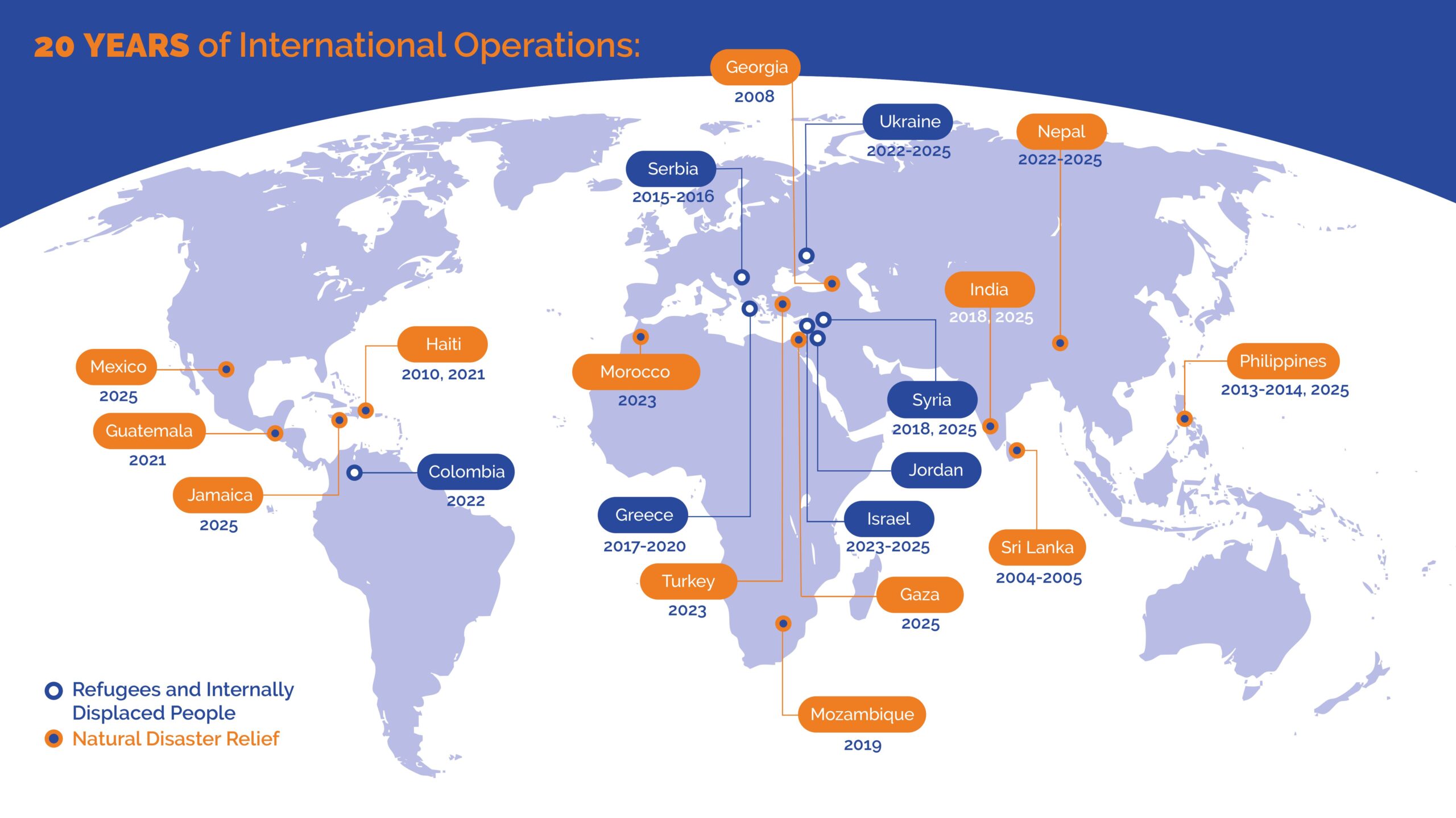
In 2025, NATAN Worldwide Disaster Relief stood at the frontlines of a world in crisis, delivering community-centered medical and mental-health care wherever systems were overwhelmed and people had nowhere else to turn. From war-scarred towns in Israel and Syria to flood-hit communities in Mexico and hurricane-devastated villages in Jamaica, NATAN Worldwide Disaster Relief focused on a precise window of time: the moment when early, expert intervention can change the trajectory of recovery.
When the Need Is There, So Is NATAN
2025 was, in many ways, a year defined by war and uncertainty, especially for Israelis. While a ceasefire and the return of hostages marked an important turning point, they also unveiled the long and complex journey of healing that lay ahead—for Israelis and for their neighbors. NATAN Worldwide Disaster Relief stepped into that moment, bridging gaps when health and social systems were under maximum strain and helping communities prepare for the long road of rebuilding.
Even as conflict at home demanded urgent attention, NATAN Worldwide Disaster Relief continued to honor its founding mission: bringing humanitarian medical and psychosocial care to vulnerable communities worldwide affected by disasters, conflict, and protracted crises. The organization’s work in 2025 underscored an enduring commitment to shared humanity, Jewish values in action, and an Israeli civil-society ethos rooted in dignity, restraint, and compassion.
A Community-Centered Humanitarian Health Model
At its core, NATAN Worldwide Disaster Relief is an Israeli humanitarian NGO that mobilizes practicing medical and mental-health professionals to deliver high-quality care in crisis settings. The organization operates through a community-centered humanitarian health model, partnering closely with local actors to stabilize individuals and communities when they are most vulnerable.
NATAN Worldwide Disaster Relief works along two main response pathways:
Rapid deployment missions that send integrated teams to operate fixed or mobile clinics, support local facilities, and deliver urgent medical and psychosocial care in acute emergencies.
Programmatic crisis responses that build longer-term, targeted interventions in protracted or complex crises, ensuring continuity, local ownership, and ethical exit strategies.
Across both, NATAN Worldwide Disaster Relief focuses on the acute crisis through early recovery window—when timely medical and psychosocial care can prevent further deterioration, reduce preventable suffering, and support sustainable recovery.
Disaster Relief Operations: From Syria to Jamaica
In 2025, NATAN Worldwide Disaster Relief responded to multiple emergencies around the world, often in partnership with local and international organizations.
Syria: In the village of Al-Hamadiya, where no functioning medical facility existed and the nearest hospital was hours away, NATAN Worldwide Disaster Relief staffed a clinic established by partner FriendShips and implemented a hybrid care model combining on-site treatment with telemedicine follow-up, including establishing the area’s first dental clinic.
Philippines: Following repeated earthquakes, NATAN Worldwide Disaster Relief deployed mobile medical clinics and then pivoted toward training teachers, youth leaders, municipal staff, and students in psychosocial first aid and resilience, in collaboration with Operation Blessing Philippines, JDC, and Airlink.
Mexico: In flood-affected rural areas of Hidalgo State, NATAN Worldwide Disaster Relief set up mobile field clinics providing triage, emergency and pediatric care, and pharmacy services, working closely with CADENA Mexico and Mexican Army medics.
Jamaica: After Hurricane Melissa, NATAN Worldwide Disaster Relief ran successive missions from assessment to stabilization, operating pop-up clinics, managing field pharmacies, and treating complex medical and psychosocial cases alongside partners such as UJA-Federation of New York, Operation Blessing, Medic Corps, the Jamaican Ministry of Health, and Airlink.
Gaza: In collaboration with Gaza Children Village, NATAN Worldwide Disaster Relief launched a dignity-kit initiative, distributing reusable menstrual health kits to 2,000 women caregivers in Khan Younis, with plans for ongoing shipments across all GCV academies in Gaza to restore dignity, mobility, and autonomy under extremely restrictive and challenging conditions.
Each of these missions reflects NATAN Worldwide Disaster Relief’s hallmark approach: tailored, partnership-based interventions that respect local realities while bringing in specialized expertise.
Israel Recovery and Regional Resilience
In Israel, NATAN Worldwide Disaster Relief played a critical role in supporting communities still processing the trauma of October 7 and its aftermath. What began as emergency response evolved into deeper, city-wide resilience partnerships and long-term psychosocial support.
In Ofakim, NATAN Worldwide Disaster Relief, working with the municipality and JDC, supported therapeutic gardening, mobile municipal services, community gathering spaces, senior volunteer initiatives, and remembrance and cultural events that reached thousands of residents. At the Mishor Hagefen Community Resilience Center, NATAN Worldwide Disaster Relief created a trusted hub combining psychosocial support, youth programming, complementary therapies, and leadership development, eventually transferring full responsibility to the municipality after two years—a deliberate handover that signaled sustainable local ownership.
NATAN Worldwide Disaster Relief also helped catalyze a unique creative healing project: a children’s book emerging from guided workshops with local children affected by the October 7 attacks, using writing, drawing, and imagination as tools for emotional processing and shared storytelling.
Beyond Israel’s borders but deeply linked to Israeli trauma, NATAN Worldwide Disaster Relief expanded its programmatic crisis response in Dharamsala, India, supporting an estimated 30,000 visits by Israeli travelers—many of them reservists and survivors—through a safe community space, group workshops, dialogue circles, and acute crisis interventions.
Innovative Programs: From Pediatric Rehab to Dental Care
In Syria, the NIFLA program demonstrated how NATAN Worldwide Disaster Relief combines innovation with compassion. In partnership with ALYN Hospital’s PELE Center, NATAN Worldwide Disaster Relief provided telemedicine-guided assessment and rapid production of adaptive devices for children with disabilities in underserved, war-torn communities, with life-changing impact—for example, enabling a 1.5-year-old with hypotonia to sit upright for the first time with a customized corset.
Within Israel, NATAN Worldwide Disaster Relief continued to expand its humanitarian dental clinics in Tel Aviv and Haifa. Operating with volunteer dentists and staff, a cultural mediator, and partnerships with organizations like Lo Omdot Mineged, Ve’Ahavata Clinic, and Shen Zen (which provided free dentures), the clinics offered free, high-quality dental care to asylum seekers, refugees, women at risk, and others excluded from the public health system, restoring health, function, and dignity.
Volunteers: The Force Multiplier
Perhaps the most powerful engine behind NATAN Worldwide Disaster Relief in 2025 was its volunteer model. Around 1,800 medical, mental-health, dental, and logistics professionals donated their time and expertise, allowing NATAN Worldwide Disaster Relief to maintain a deliberately lean operating structure while maximizing impact.
For the first time, NATAN Worldwide Disaster Relief quantified this contribution: for every 1 dollar invested in the organization, an additional 1.3 dollars in value was generated through volunteers’ in-kind professional service. In 2025 alone, volunteers contributed an estimated 972,000 dollars in in-kind program value—more than half of the total value of humanitarian operations—enabling donor funds to focus on readiness, safe deployment, medical supplies, logistics, and governance rather than fixed staffing costs.
Donors and the Power of Shared Responsibility
Behind every mission of NATAN Worldwide Disaster Relief stands a network of committed donors and partners. In 2025, the organization raised 440,000 dollars, 74 percent from American donors and 25 percent from Israelis, with around 80 percent of donations coming from foundations, religious institutions, municipalities, and businesses, and 20 percent from individuals.
Support from synagogues, federations, foundations, and many individual donors enables NATAN Worldwide Disaster Relief volunteers to reach survivors of disaster and conflict when they need help most. That generosity is not only financial; it is an expression of shared responsibility for people facing crisis—from child survivors of war in Syria and Gaza to families rebuilding their lives after hurricanes and floods.
For those who wish to stand with NATAN Worldwide Disaster Relief, there are two central paths: donating to sustain its lean, high-impact humanitarian model, and volunteering as a professional to join missions and programs worldwide. Both are acts of presence—showing up when the need is greatest, and helping ensure that, wherever disaster strikes, NATAN Worldwide Disaster Relief can be there.