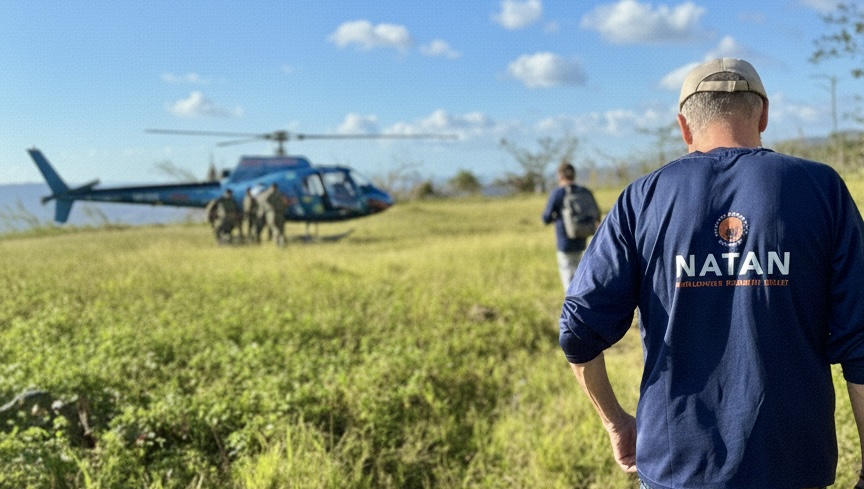
“When we spoke in the helicopter… the pilot said: ‘We are bringing them hope.’ And as corny as that sounds, I think it comes with a lot of healing power. Maybe giving a few pills for blood pressure comes with a little healing power, but showing people that we listen, that we care, that we showed up… I think that is of great value.” — Dr. Neil Richmond, NATAN Volunteer and Emergency Medicine Specialist
When Hurricane Melissa tore through Jamaica, it left behind more than just physical debris. It left isolated communities, families without shelter, and a healthcare system pushed to its absolute limit. In response, NATAN Worldwide Disaster Relief deployed three consecutive delegations over five weeks. What began as a high stakes race to reach mountain villages evolved into a deep mission of community healing and long term partnership.
Reaching the Unreachable
The journey began in the air. With roads blocked by massive landslides, our first team worked alongside the Jamaica Defence Force and MEDIC Corps to perform aerial triage. Villages like Catadupa, which had been completely cut off from the world, saw help for the first time when our helicopters touched down.
These early days were defined by high pressure, life saving moments. As a NATAN volunteer on the front lines, Dr. Neil Richmond and his colleagues focused on breaking through the barriers of geography to provide immediate care. From the emergency evacuation of a dialysis patient to stabilizing a two week old infant struggling to breathe, the team was there to provide a bridge to safety.
Medicine Beyond the Clinic
As the floodwaters receded and roads became passable, the NATAN mission moved into the heart of the communities. We established a rhythm of mobile clinics, transforming local churches in places like Richmond Hill and Banana Ground into hubs of healing.
In Banana Ground alone, our team saw over 50 patients in a single day. But our doctors and nurses weren’t working alone. Our Psychosocial Support teams were on the ground, navigating a complex emotional landscape. They found that while many were in “survival mode” — focused purely on finding clean water and food — there was a profound need for psychological resilience. By joining local community relief days, our social workers helped mothers and children begin the long process of emotional recovery.
Strengthening the System
A disaster response is only as strong as the legacy it leaves behind. In the final stretch of the mission, NATAN’s focus shifted toward institutional support. Our medical professionals went through the rigorous process of securing official licenses from the Jamaican Ministry of Health, allowing them to work as peers within the national system.
By integrating directly into the Cornwall Regional Hospital ER, our volunteers helped alleviate the heavy burden of burnout on local staff. We also looked toward the future of the families we met, distributing roofing sheets, hygiene kits, and cleaning supplies to ensure that as we left, the work of rebuilding their homes could truly begin.
The Power of Partnership
No mission of this scale happens in a vacuum. The success in Jamaica was built on a foundation of collaboration. We are deeply grateful to Operation Blessing for providing our logistical home and pharmacy chain, to the Jamaica Defence Force for their protective wings, and to Project Dynamo and MEDIC Corps for their unwavering support.
A Legacy of Caring
Over the course of this mission, NATAN treated nearly 1,000 patients across more than ten locations. We operated in makeshift clinics without advanced diagnostic tools, relying instead on clinical expertise, improvisation, and most importantly, empathy.
We learned that disaster relief is about more than just medicine. It is about the power of presence. Whether in a helicopter over the mountains or in a crowded hospital ward, we showed up to listen. We showed up because we cared. And in doing so, we brought a little bit of hope back to the island.